March 6, 2012

No snow this winter, but darn cold

written by Yvonne

Germination of seeds planted two weeks ago has occurred. Namely butter crunch lettuce, radishes, and onions.  Here you can mostly see the lettuce.


This week I planted batch #2 of the butter crunch lettuce, radishes and onions in pots.  Also started were beets, broccoli, cauliflower, kale, mesculm lettuce, red sails lettuce, and all of our herbs including basil, cilantro, rosemary, marjoram, chamomile, chives, bergamont, and oregano (I think that was everything.)


A friend of ours gave us this handy seed sorter. It worked for some seeds, but not all.


Everything was put into the mini-greenhouse with the hope that it's warm enough in there to encourage growth.


Olive and I also planted batch #2 of the carrots and peas (hee hee).


Two of the snow peas from batch #1 have already come up.  They just can't wait to push through and start producing!


Tom finally got to feeding his worms.  He said they're doing great and producing lots of castings. Now that we're starting the majority of our seeds in pots, we'll be using more worm casting than ever.  Once it gets a little warmer outside, and once he's taken care of whatever is pressing with the bees, he'll do another harvest of castings which I'll mix into the potting soil used to plant our seeds.


This sure does look like a lot of green stuff growing, doesn't it?  Well it is, but only some of it is what I want.  The dark green, fuzzy stuff on the left is dill and the two patch to the front-center and right are thyme. Everything else is weeds which I pulled out.  (Guess I should have taken an after picture to show the difference.)


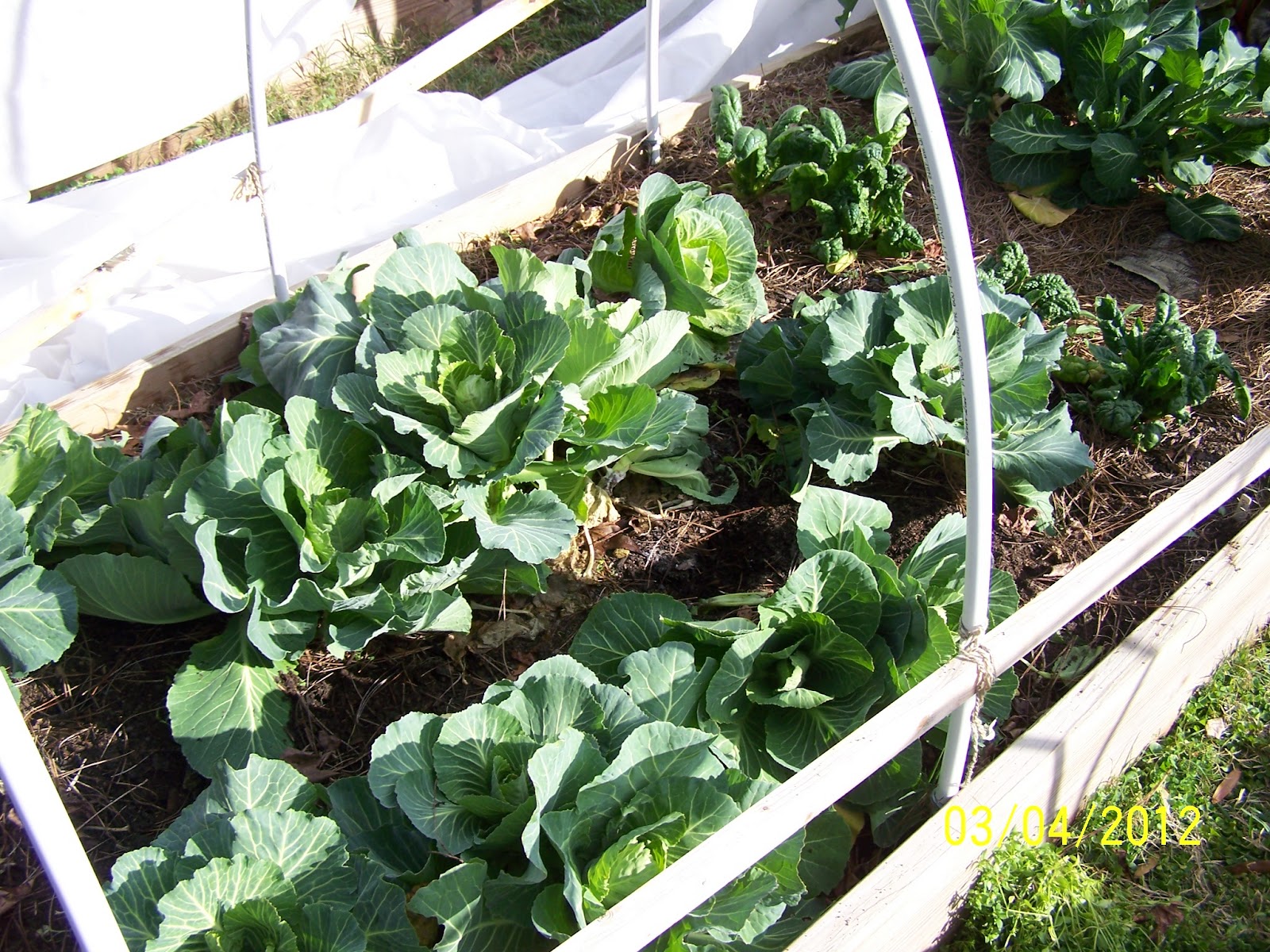
Cabbage plants EVERYWHERE but only a few developing heads. A certain someone advised another certain someone that it was too many to be planted in one area.  I, er, uh, that someone was right.  So that same someone went though and pulled out any plants that were small, crowding another plant, or didn't have a head.  This is the before...


And this is the after.  Some actually did have heads forming which is great because I didn't think any were.  Now THIS looks like the right amount, wouldn't you say?


Here the collards, dog head, and Swiss chard are all doing well.


This item perplexed us. It's at the end of the of the Swiss chard row.  Both of us agreed it looks more like arugula than chard... and yet there are leaves that look like chard too.


Upon further investigation, it was both. There was an arugula plant (right) growing super close to the chard (left) and they had become intertwined.


I preformed a little open chard surgery (Tom came up with that one) and did my best to gently separate the chard from the arugula.


The surgery seems to be a success but we'll need to keep a close eye on it to see if the chard makes a full recovery.


With the large arugula successfully removed...


it was time to commence eating!

February 21, 2012

Plannin' It Out

written by Yvonne

It's finally time to hit the dirt!  Just a little more planning so that things will go smoothly once I start planting seeds.  Since I've committed to succession planting, I got all the dates written down so I won't get confused. I double checked the dates on the packets (along with the last frost date) so I wouldn't be tempted to put things out too early.


Once I have are few dozen newspaper pots with small, green things growing in them, I'm going to forget what got started when.  I thought marking the pots with #1 or #2 might be a good idea (the numbers indicating whether it was the first or second planting of that item).  And since the pots are paper, it also seems like a good way to mark what seed is in each.  If this works, it will be much more efficient than having little sticks stuck in each pot, or what we did previously which was to mark the container the pots were in. I was pretty happy with myself for thinking to write on the pots BEFORE I filled them with dirt. The newspaper will get dark once it's wet so we'll see if I can still read it.


The soil is a combination of potting dirt, peat moss, and our very own worm castings.


I'M HAPPY!  Finally newspaper pots are getting filled with dirt and seeds!  Seems like this has been on my 'got to do this weekend' list for three weeks now! The seeds planted this round are onions (bunching and white), radishes, and buttercrunch lettuce.


I mixed up a batch of Jerry Baker's Seed Starter Tonic to encourage the seeds to grow strong and fruitful.  The tonic is a mixture of tea, ammonia, dish soap, and whiskey.  (Tom didn't think it was fair that the garden got to start drinking before we did.)


After watering the seeds I sprayed the tonic on the tops of each seed. Then I zipped up the mini-greenhouse to keep the seeds warm.  At some point we're going to get a thermometer to stick in the greenhouse to see how much warmer it is than outside.


Seeds that were sown directly into box #4 were sugar peas, cowpeas, and two kinds of carrots.  We both giggling every time I said "peas and carrots".  Guess we thought it was funny 'cause that's what you hear mom's tell their kids, "Eat your peas and carrots."  (Maybe you had to be there.)


While I was getting the Spring vegetable garden off to a good start, Tom finished trimming trees in the yard. Several weeks ago he trimmed the two biggest crepe myrtles; one of which was growing up into the electrical wires, and the other was overpowering our driveway.  This weekend he trimmed back the next two largest crepe myrtles and the apple tree (shown here).  Can you see him?  Of course Olive was outside helping us both with all of our outdoor tasks. She's even  harder to find, but she's in this picture too.


Don't forget - If you're looking for updates on the bees, go to TsBeesHoney.com.  While you're there, fill out the Contact T's Bees page and you'll be notified when honey is ready for purchase.

February 14, 2012

Update on winter growings

written by Yvonne

Winter is FINALLY upon us here in Charlotte and boy, was it wintery-cold this weekend! It made for good indoor activities like fires and cooking soup. Motivation to do anything outside was nonexistent.  So getting our seeds started will have to wait yet another weekend.

Here is how things look in TYs winter garden...

I'm super impressed that dill is growing.  Thanks to our mini greenhouse, we started these seeds in fall, transplanted it, and because of the hoop houses it not only survived, it's growing!


Same with the thyme.


(Sorry that a few of these photos are blown out a bit). The garlic is doing fantastic...


as is the arugula. I pulled out one plant because they are getting a little crowded and so we would have some to eat for a few days.


I harvested about a dozen of the larger spinach leaves and tossed them with the arugula to make several hearty salads.


I also harvested collards and threw them in a soup for lunches this week. I have a new collards recipe to try this coming weekend that promises to be quite tasty.


TONS of cabbages coming along.  The heads are just starting to form.  This is a good illustration of why we are going to succession plant.  All of these cabbages are going to be ready to eat at the same time.... that's a LOT of coleslaw, my friends!


The harvested bounty for the week.


If you're looking for updates on the bees, go to TsBeesHoney.com.  While you're there, fill out the Contact T's Bees page and you'll be notified when honey is ready for purchase.

February 7, 2012

More prep work

written by Yvonne

Using last year's notes and the NC Agriculture Extension Service's Vegetable Gardener's Guide, I planned out a rough planting timeline for everything we want to grow in the 2012 TY Veggie Patch.  Tom determined the last frost date of the year to be April 2 so we'll use that as a guide when determining a safe date to put plants in the beds. In 2011 we learned some valuable things that we'll apply to this year, including:
  1. Sow direct. If one of our reference books or the packet of seeds reads "sow direct", we will do so. We will not start those items in pots no matter how anxious we are to get them started. This seems to be the case for most of the root vegetables but a few other things as well.
  2. Use tonics. We really slacked off using Jerry Baker's tonics last year.  We're going to be more diligent in applying them this year.  We sprayed on a few Green Up tonics but that was it. One I came across this weekend is a Soil Starter tonic. He says to use it two weeks prior to planting to get the soil ready to receive transplants and seeds.  I'm definitely applying that one this year.
  3. Succession plant. We've read about it.  It makes sense. Sounds like a great idea.  Never actually done it.  For me, it has finally sunk in how to do it and why.  Let's say we decide that four butter crunch lettuce plants are sufficient for the season.  Instead of starting all four plants at the same time, we will start two plants now and two weeks later, start the other two.  This way instead of having all four plants come "online" at the same time, two will be ready and by the time we're done eating on that, the others will be up.  We're doing this with EVERYTHING we plant. By doing so, hopefully the bounty will be spaced out over a longer period of time and we won't be inundated with 116 cucumbers in a three week period. The part that will take some brain powers is making sure to leave enough space in each bed for the plants yet to come.


During the Super Bowl, I cut strips of newspaper and we set to making a bag full of pots to start our seeds this coming weekend.

January 30, 2012

TYs 2012 has officially begun

written by Yvonne

A new year, a new set of seed catalogs, a new start to what will be a prosperous and plentiful growing season!  After taking inventory of our current seeds, we figured out what was missing and placed our order - a super exciting moment in a gardener's life. This year, we ordered seeds from two companies: Sow True Seed based in Asheville, NC and Southern Exposure Seed Exchange in VA. We would have gotten them all from Sow True but they didn't have a few herbs we needed.  Next up? Get the newspaper pots ready for all these seeds.


Last year Tom included news and updates of his apiary (bees) on TYs Veggie Patch. This year, he will be blogging about bee adventures, as well as taking orders for honey on his NEW web site - T's Bees Honey. You can find it by clicking here www.tsbeeshoney.com.

If you'd like to be put on a contact list for purchasing honey, be sure to go to Contact T's Bees and fill in your information. Once honey is available for sale, he will contact interested people.  It will be first come first served.  As a first year beekeeper he won't really know how much honey to expect so if you want to buy some, be sure to get on his list.

January 16, 2012

BEES: Wrapping up for winter

written by Tom D.
I know it's been a long time since I put a bee post here, but work has continued to prep the girls for winter. I also received my official NC Certified Beekeeper certificate from the state, and was elected VP of the Mecklenburg County Beekeepers. Lots has been going on. :)

In September, a month had passed since the split. I fed them heavily with thin syrup, and they were at close to full strength in just a month. As you can see there was lots of bees to be found. This is Hive Boris, who appeared to be doing quite well.


A nice frame of bees and brood in a beautiful compact circle. The queen was doing well and laying lots of eggs which I found on this inspection.


In October I was surprised to find one of my bees on a cabbage head. What was she doing? I looked more closely and she and other bees were drinking morning dew collected by the leaves. I realized I needed to replenish the bird baths nearby so they could get water in.


Work continued on both hives in prep for the winter. I continued feeding, but switched to heavy syrup on my plastic top feeders. The heavy syrup crystallized like crazy in my top feeders and became a pain. I suspect that stirring the sugar once it got to the melting stage in the water might have been to blame for the crystallization. I'll find that out next fall.

While the bees were bringing in tons of goldenrod and aster pollen, strange critters started showing up like this praying mantis.


She seemed to be missing one of her legs but it didn't seem to slow her down much. Those eyes are freaky!


Pollen, pollen, pollen! I left the mouse guard on both hives ever since my late summer split, and will keep them on until Spring 2012.


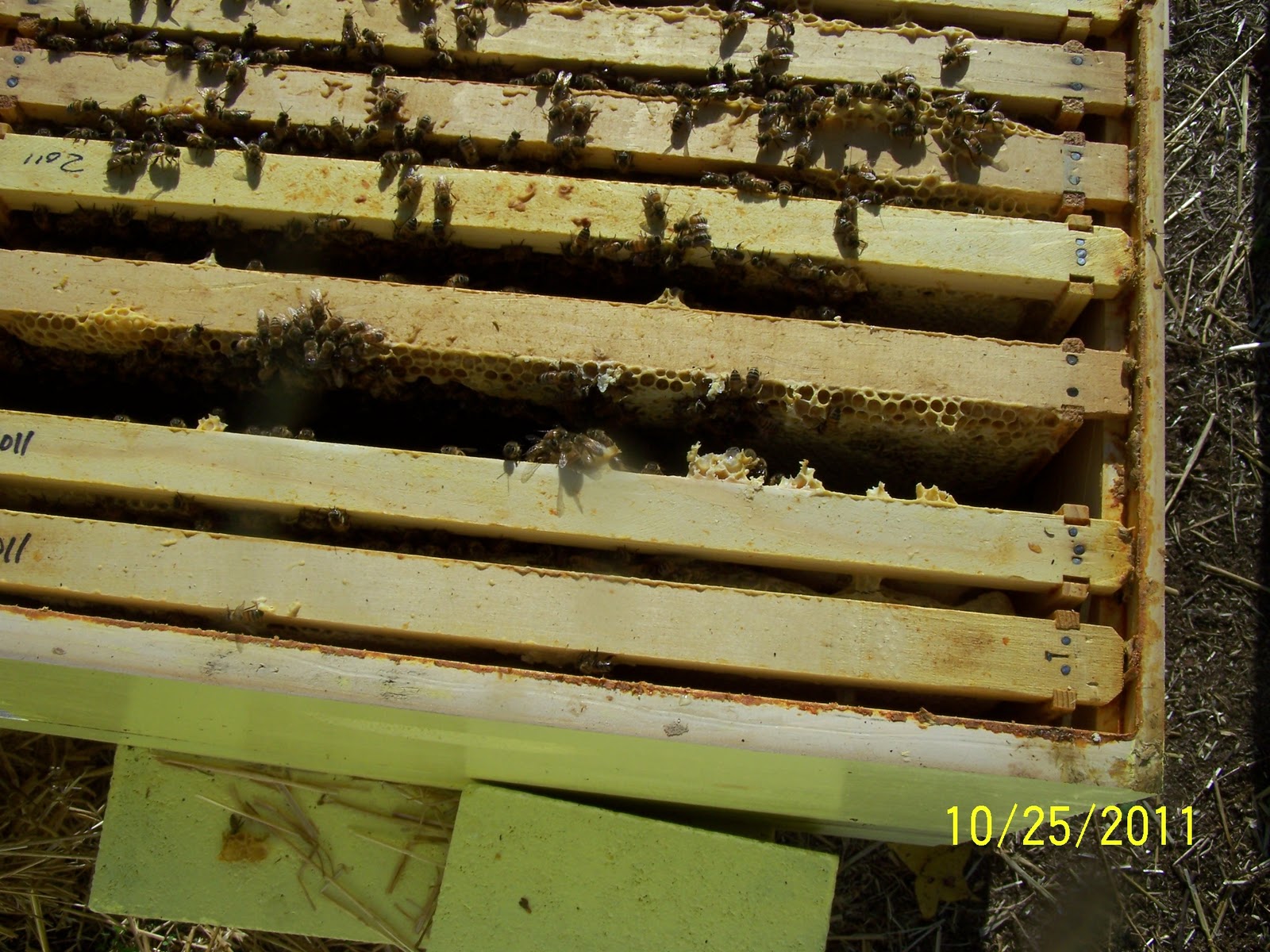
One of my last inspections. The top of Boris. Each deep box had at least 6.5 frames of syrup honey. Since I use 9 frames in a 10-frame box, the comb is drawn out deeper, holding much more honey in its cells. It's part of my winter strategy. I made the dubious error of picking up the top box of Natasha, forgetting that each honey frame weighs about 9.5 pounds each. My back and left forearm still haven't forgotten! Lesson learned: use a work box, goofy! All was quiet up top. It was the end of October and time to make my last inspection of 2011.


Some bur comb needed to be cleaned up. I removed the beetle traps since only one or two seemed to be in them. Hopefully that wasn't a mistake for winter.


One dead small hive beetle.


A beautiful capped honey frame, that still wasn't fully drawn out.


Things were a bit of a mess. More cleanup. After seeing how messy the interior can get in just a few weeks, I realized that initial inspections in Spring will mean lots of cleanup, removing burr comb and excess propolis.


Another honey frame with a side only a third drawn out. Each box on both hives had about 6.5 honey frames each, or about 13 per hive. That means each hive will have about 120 pounds of food for the winter. So far it's been a mild one, so they should survive easily and not starve to death. We only need about 50-70 pounds per hive here in the mild climes of Carolina, I've been told. The hives were packed with pollen. It fell out of the cells as I turned the frames over to inspect them. Fortunately the pollen fell back inside the colonies.


Here they're working on evaporating that syrup down and starting to cap it. The freshly drawn comb is so beautifully white.


Okay, I'm beginning to overstay my welcome. Hive Natasha had a ton of burr comb built between the boxes, and they didn't take too kindly to me interrupting their work. Fall bees became nasty, aggressive bees. They get quite defensive, I found out on more than one occasion! I also brought bales of wheat straw in for winter wind breaks.


A larvae fell out of one of the burr comb cells, and she was swiftly snatched down into the hive by some nurse bees.


My bees seem to be VERY attached to their beekeeper. This solo girl on our back screen porch was saying "Goodbye 2011!" or "Let me in, it's getting a little cool out here!!"


Here you can see my final winter bee yard. I put up the straw wind breaks on the outside of both hives  and one each at the back and front. I left on my summer screened inner cover at the top and screened bottom board to allow for lots of ventillation. This will keep the hives from being killed off by the freezing condensation that can drip down onto them if air flow is constricted. I believe we have to make strong colonies so they can keep themselves warm, not keep a warm hive, which can lead to the bees eating too much food and eventually starving during the winter months. 

Here you can see the girls in late December on an unusually mild day of mid-50s coming in from foraging for pollen (they actually were coming in with some bright gold and a little bit of white pollen ... where were they getting that?). LOTS of orientation flights were taking place it seemed, too. You can also see my straw bales setup. I've since moved the side bales to about 5 feet away, since they're there for a wind break only. I couldn't believe how many flight were going on in late December. They seem to be taking off at 53 degrees. I've seen pollen coming in at the mid-50s degree range this winter.

 
That should do it until early Spring, which is right around the corner in just another month and a half. Hopefully I'll find I was successful in over-wintering my first two hives, thus making me a beekeeper and not a bee-haver. One of my mentors, Hernan, thinks I'm crazy for putting up the bales, calling them unnecessary. We'll see if I'm crazy ... like a fox (or not)!

January 12, 2012

VEG: Last post for 2011

written by Yvonne

Although it may seem like there's not much going with TYs Veggie Patch these days, you'd only be partially correct. We've been enjoying the collards, lettuce and arugula that have been growing these last several months under the hoop houses. And we started some turnips, onions and parsley in the green house which we planted earlier last month (pictured here).  They've been slow to take off but we haven't given up on them - yet.


This past week we took off the row covers to take advantage of the rain and sun. What a mild winter it's been so far! We pulled out the remnants of the last lettuce plants and harvested some collards, which we'll be enjoying with grits for dinner tonight.

The seed catalogs have been arriving which is super exciting. I've updated the current seed inventory so when we map out the spring garden this weekend, I'll know what seeds need to be ordered. Soon I'll be making newspaper pots and Tom will be getting worm compost ready for us to start the seeds. We're really going to maximize use of our small green house and get a jump on spring.  No wimpy spring/summer garden for us this year!