Showing posts with label bees. Show all posts

April 26, 2015

Yep... Still Green

written by Yvonne

Honey and Olive wanted to make sure everyone knows how much they help in all of our gardening endeavors.  They did a good job of making sure these bales of straw didn't blow away.


And yes, you guessed it. We are still (happily) eating spinach and lettuce!  Baskets full!


And there is still plenty more growing!  Actually, after harvesting a good amount of the spinach pictured here, we started pulling up the plants because they've begun to bolt.


This is the other end of the lettuce/spinach bed. Tom tilled it and planted (from left to right) snap peas, Provider bush beans, Maxibell bush beans.  In the background you can see new rows of spinach coming up in bed #3.


The collards, Swiss chard and kale are just about ready to eat.  Next weekend I'll likely make something with the Swiss chard. Upon further inspection, Tom determined that the large plant in the right foreground is a couple of turnips, not collards.  Still good eatin' either way.


Only a few of the peas have come up so far (center).


This volunteer cucumber showed up out of nowhere. It's a little early for cucumbers but if it wants to come up now, fine by us.


Still plucking off the strawberry flowers and it seems to be working because the plants are really growing nicely.


We are a behind in starting summer seeds. We should have started melons, squash, peppers and tomatoes a few weeks ago, but there are only so many hours in a weekend.  Tom filled up the pots I made with dirt and tomorrow I'll get some squash, melons, and pumpkin seed started.


Tom also tilled the garden annex area. Ya know, I think we just like having this as potential so we get it ready every year and think we're going to find just the right thing to make it work. Yes, a few squashes materialized last year, but for the most part, it's been a dud. Well NO MORE! Boy do we have plans for it now!  You may recall we purchased rosemary and two kinds of mint plants in early Spring. This is where they are going to reside and we have high hopes they will 'take' since both are aggressive and hearty. We've managed to keep the plants alive through some really cold weather. Now that the bed is ready, they'll get planted tomorrow.  THEN, we're going to take chicken wire previously used for compost bins and hang it on the outside of the carport.  We'll secure it down at the bottom of this of brick wall with stakes.  Then we'll transplant some jasmine at the back of this bed and let it grow up the chicken wire.  We'll have a nice beautiful natural wall blocking off the ugly carport. It'll make for a much nicer view from the back patio.  We did the same thing several years ago on one end of the front porch and it's worked great.


Whew!  It's finally done! And what a job it was. It took two weekends, many hours, 3 broken tools, and MANY loads of brush wheeled to the front yard for pick up.  But the back fence line has now been completely cleared out. We cleared a third of it together two weekends ago then Tom finished the last 2/3 by himself.

Here's what it looked like before....


and here it is after!


Before...


after!


This is before mostly shows the overgrown compost bins. Nonetheless, here is before...


and after!  Doesn't even look like the same yard, does it? Now that it's a nice open, accessible space Tom was able to get to the trees to hang some bee boxes. (Read more about that later this week at www.tsbeeshoney.com.)  Our neighbors told us numerous times over the weekend how great it looked. Guess it was worse than we thought.


April 9, 2013

End of Winter, into Spring. Work, work, work!

written by Yvonne

This post is an accumulation of about three weeks worth of gardening work. Instead of writing about it by the week, it's categorized by areas of the garden.

GARLIC

The grass had grown SUPER high around the garlic and it was gonna take some time to dig through and determine what of the tall green stuff was grass and what was garlic.


Describing this as similar to finding a needle in a haystack may be a slight exaggeration, but not by much.  The garlic looked ever so slightly different from the grass. The grass was so intermixed, it wasn't possible to pull the grass out without disturbing the garlic, so I oped to just cut the grass as close to the soil as possible.


These two piles of grass is what I cut from around the garlic.


Last step was to put hay around each bulb of garlic. Whew! What a job. If Ruth Stout's hay mulching works, I'll never have to do that again.


POTATOES AND ONIONS
This area is where we've grown potatoes before. Last season, we planted both onions and potatoes but the onions never took off. Or so we thought....


Upon closer inspection, there are onions growing here (kinda hard to see in this picture, but they're there). We started a round of onions in pots this year and Tom added them to this patch as well.


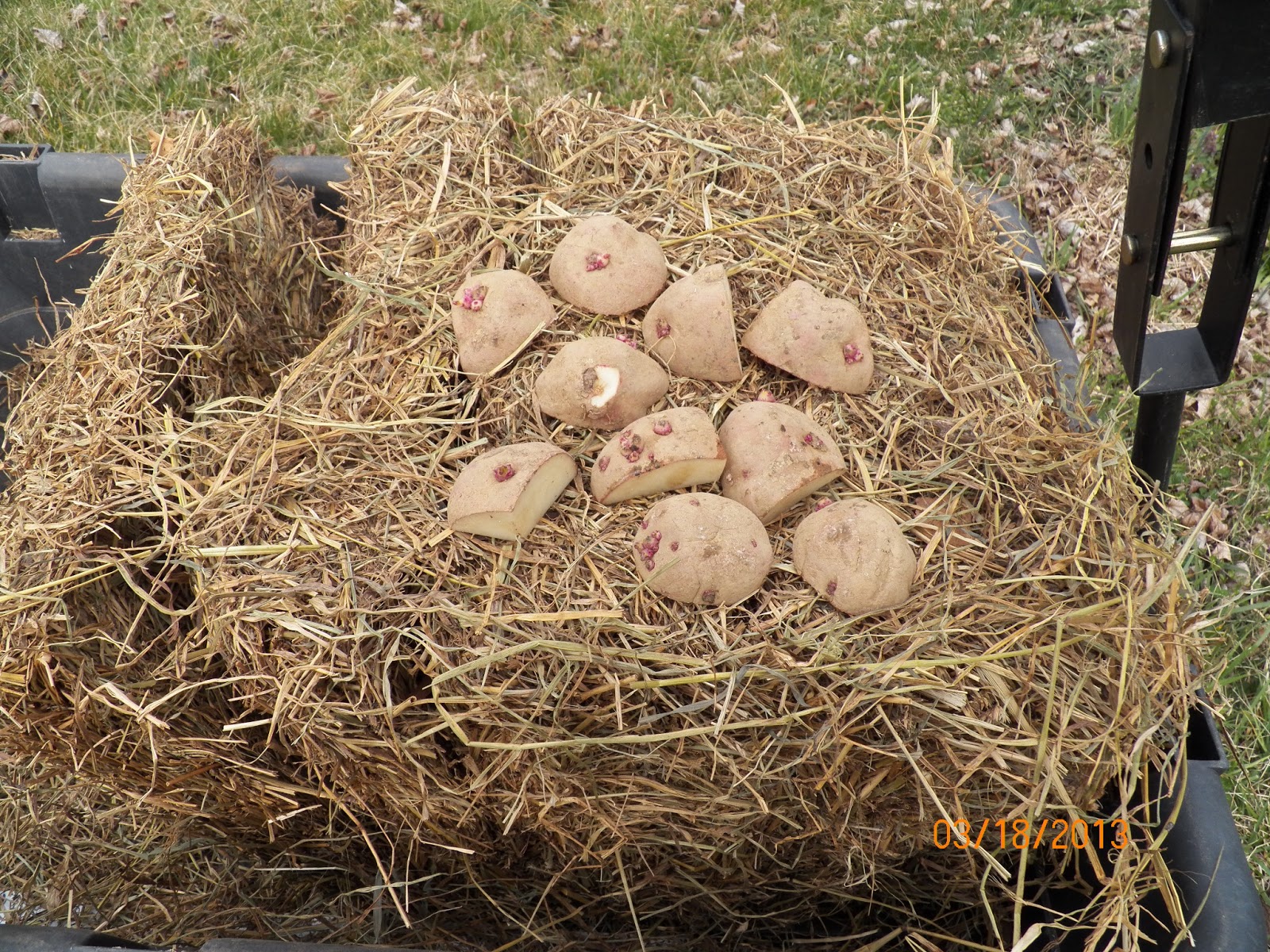
I threw the potatoes on one end of the potato/onion bed and then covered them with a thick layer of hay. We'll see if they spout this way or now.  It'll be SO cool if they do!  (I have doubts.)


PEAS

Granted, it has been cold, but gosh darn it these peas are taking their sweet time.  This big white ball in the photo is the pea seed pushing out of the ground ready to open up.


Here is one that has shed its outer hull and started to actually sprout.


NEW PLANTINGS (IN POTS)

Time for even more seeds to go into the greenhouse.


All the herbs, tomatoes, peppers, cucumbers and round two of broccoli, kale, and more greens are all in pots now.


The first round of collards, kale, onions and broccoli are doing pretty good at this point.


PARSLEY

I'd uncovered a parsley plant no too long ago.  It sure is great to have such flavorful parsley at the ready when cooking! I spread another row's worth of seeds next to it so there would be plenty through the spring and summer.


COLLARDS

After putting the hay down just a few weeks ago, the collards, spinach and cabbage grew significantly and they all turned greener. I couldn't believe how much of an impact the hay has made in such a short time! Since the second round of collards had sprouted in pots and was read to plant, I thought the best thing to do would be to...


pull all the collards out and make space for the new seedlings. So I did just that. Once the plants were pulled up...


I pushed the hay to one side...


and carefully separated the seedlings from one another and planted them in the space where the previous collards had been.


And now it looks like this.


And here's how much I pulled up. Three baskets full!


Tom and I made an assembly line to blanch the greens and set them in 10oz nests for freezing. We were able to get 5 10oz nests out of the three baskets full.


BERRIES
We blinked and all of a sudden the berries started blooming. These are canes that didn't produce berries last year and supposedly they will produce berries this year.


We didn't get all of the canes cut back and now (obviously) it's too late cut them. So we may just wake up one morning to find our cars completely surround by fast-growing raspberry and blackberry canes.


DIRECT SOWING

Several items do better by sowing them directly (versus starting them in pots) so Tom got to work doing some direct sowing. First thing he had to do was clear the hay completely off the planting area. When planting seeds direct, you have to get them at least to touch the dirt.


Once the hay was removed, he sprinkled seeds in the dirt and patted them down.


Here is a nice half-bed worth of lettuces...


and another quarter of a bed of spinach, carrots and beets.


Once the seeds sprout, we'll pull the hay around the plants, like we did for the spinach and collards.


There's lots of activity going on with T's Bees these days. If you want to read all the buzz, go to www.tsbeeshoney.com.  Also, if you want to know when the 2013 crop of honey is ready for purchase, click on the Contact Ts Bees page and fill out the form.

March 12, 2013

Hay: It's Not Just for Horses

written by Yvonne

We FINALLY harvested some greens - spinach and collards.  And boy were they delicious!


We've also been enjoying carrots as well.


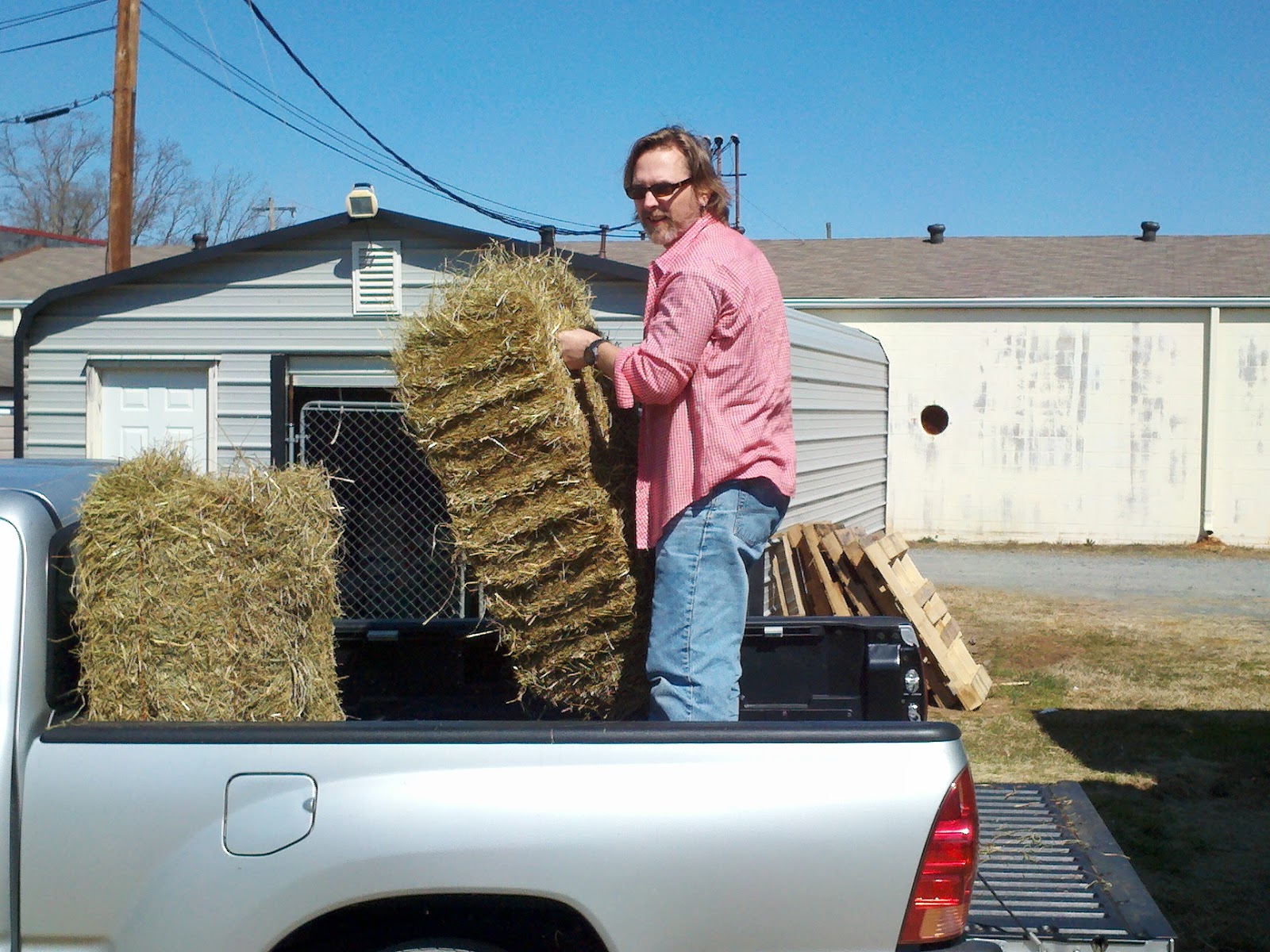
As Spring fast approaches, we needed to get hay to implement the Ruth Stout gardening method.  So we made an outing to Woof'N Hoof in Mint Hill.


We hadn't a clue how much hay to get. All we know is that the hay needs to be 8" thick to start and more will be needed once that all settles down. We filled up Tom's truck with12 bales. We should have gotten a clue that we over bought when the woman at the store said, "How big IS your garden?" I very proudly said, "Oh, it's big."


Now that Tom has thousands of other critters to take care of (bees), the worms have taken a back seat. It just became too labor intensive to keep up with the worm compost so we decided to dismantle it.  We'll still compost our kitchen scraps, but they'll go in the big composting bins with grass clippings and yard waste.  That way we're only keeping up with one composting system rather than two. Nonetheless, Tom put the worms to good use by scooping up all the worms and all of their castings....


and relocated them directly into the garden.


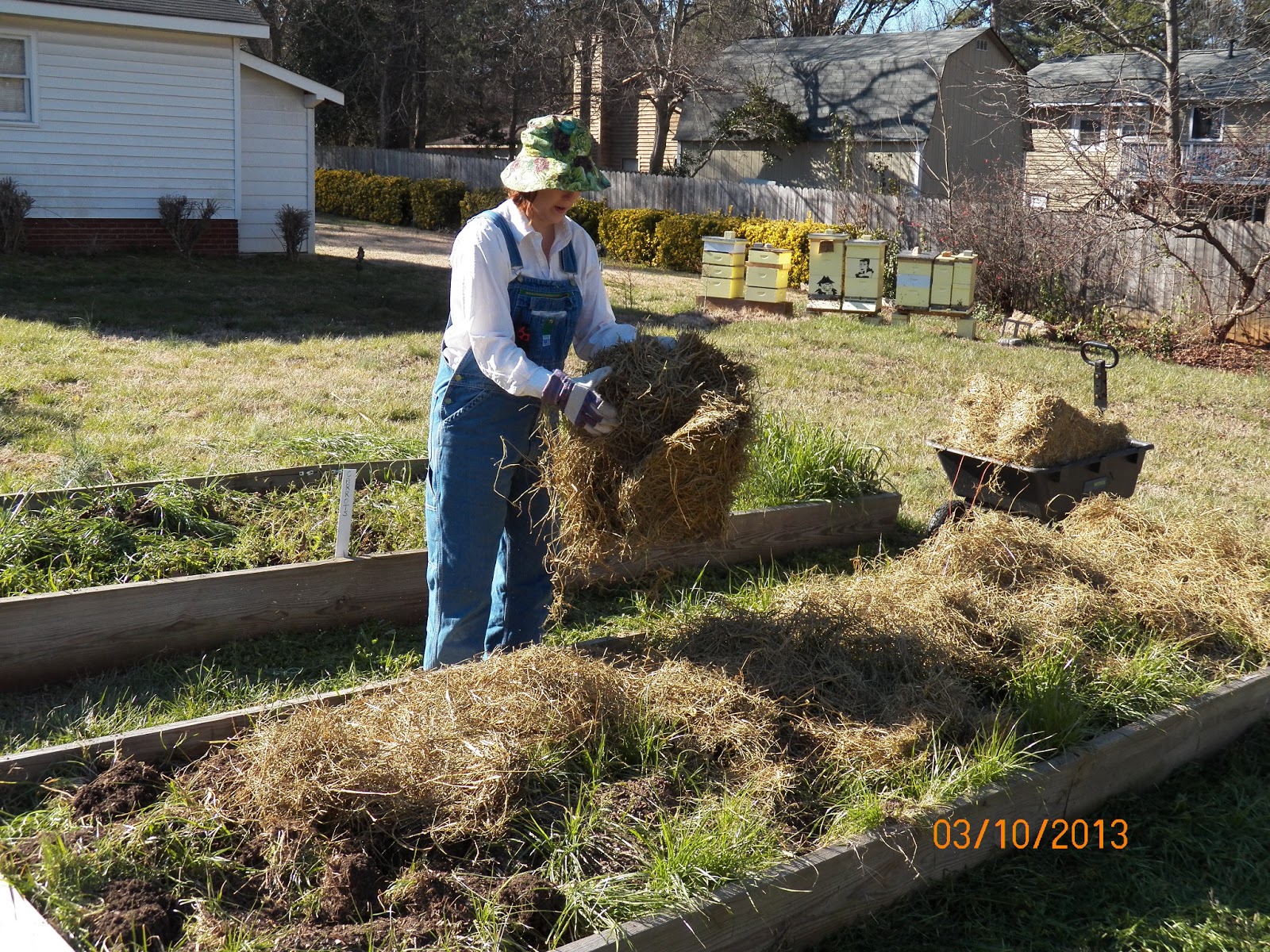
Once that was down, the spreading of the hay began. One of the beauties of Ruth Stout's method is that you shouldn't have to weed a bed ever again. You simply pile more hay on top of the weeds and that snuffs them out. So, we figured me might as well test it out from the get-go and simply pile the hay on top of the weeds. Bed 2 had all the rye grass in it which Tom turned under several weeks ago. However, much of the grass re-rooted so instead of tilling it under, I just piled the hay on top.


Then I piled some more...


and more...


until we had a good 12" layer.


Critics of Ruth Stout's method say that the hay makes for an unattractive garden. Personally, I'd rather see the hay than weeds. I suppose it's not super attractive, but you know what? If it makes easier work of gardening, who the heck cares? (That was her philosophy too.) Besides, it's in the backyard and as of yet Home & Garden hasn't come knocking on my door, requesting a photo shoot.


I thought we'd give this patch yet another try. We tried for a few years to get something happening in this mostly shady spot but nothing took root (except weeds). Last year we didn't try anything. So I layered it with hay and we'll plant something or other in it soon.


When you have plants growing, like this cabbage (left), you simply pull the hay around the base of it, keeping the moisture locked into the soil and the plant exposed to the sun and rain. Then, you mush down the weeds (right) with a thick layer of hay. Ironically, after tucking the hay all nice and neat around this cabbage I ended up harvesting it for dinner the next night. I pulled the pant out, cut the head out of the middle, left the rest of the plant in the bed and covered it up with lots of hay. From here forward, that's how we're to handle the 'waste' material from the garden. Instead of taking out the stalks and roots of plants, we are to lay them down, cover them with hay, and they'll compost right into the bed.


I tucked the hay all around the rows of spinach...


as well as the collards. You'll notice I didn't put any hay to the left of the collards. That's because there are pea seeds planted there which haven't sprouted yet. Anywhere seeds have been planted should be free from hay until they sprout. Otherwise 1. you won't know where the seeds are and 2. they won't grow because the sun can't get to them.


I tucked hay around the remaining cabbages as well.


Here is the before, where most of the green you see in Beds 1-3 are weeds...


and here is the after.  The green at the far end of Bed 1 is garlic and a lot of weeds. I have to take some time to clip out the weeds before spreading the hay around the garlic. But that'll be another day. Our last frost date is April 15 so we're keeping the hoop houses on Bed 4 where the spinach and collards are just in case we get a freak winter storm between now and then.

Remember when I said we didn't know how much hay to get? Well it took all of three bales to cover what you see here and the misc bed up near the house. Needless to say, we overbought by a little - 9 bales too many! Oh well. We'll definitely use one more bale to cover the potato patch and to finish out the rest of these beds and there's no doubt we'll use more as we go along.

Oh, and if any of you want to start using the Ruth Stout mulching method of gardening in your own garden, no need to find a source for hay. We have some to sell ya! If you're in Charlotte, we'll even deliver it to you.